
Technology
How we make carbon do what it should.
01
Filament winding
In 2015 Velocite became the first bicycle company to make carbon rims by filament winding, and won a Eurobike Award for it.
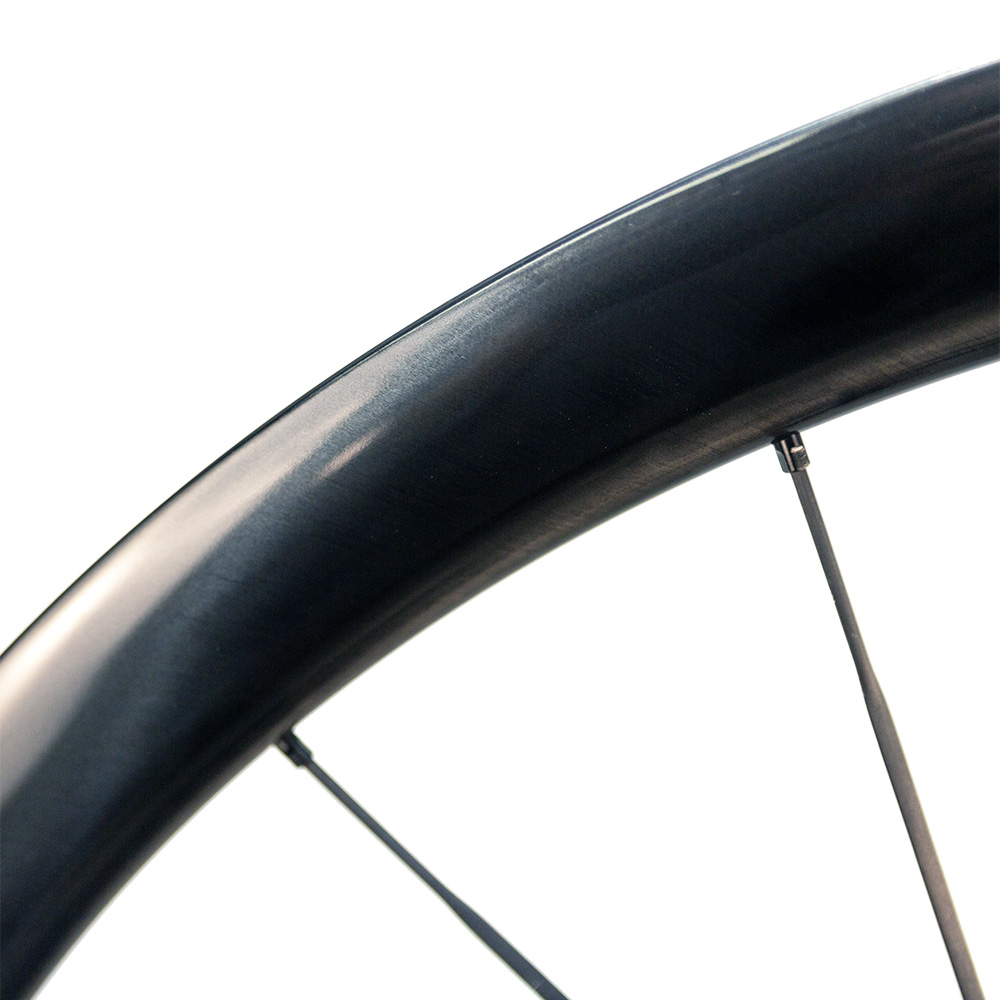
A hand laid rim is built from dozens of cut carbon patches. Every edge is an overlap or a gap, and every rim is slightly different from the last. Filament winding replaces the patches with continuous prepreg tape, wound around a rotating mandrel by a computer controlled machine at the angles the design calls for.
The result is a rim with consistent fibre angles, consistent resin content and no patch edges, compression moulded to a surface smooth enough to leave uncoated. It is the process behind the Venn filament wound rims.
02
Carbon layup
Carbon is anisotropic: stiffness comes from where the fibre goes, not from the shape of the tube.
Our frames used blends of ultra high, high and intermediate modulus unidirectional fibre, up to 13 layers deep where the loads are highest. We have used spread tow materials such as TeXtreme since 2012. The same thinking decides the layup of every rim and part we develop today.
Read: carbon fibre, from tow to layup
03
Frame and part design
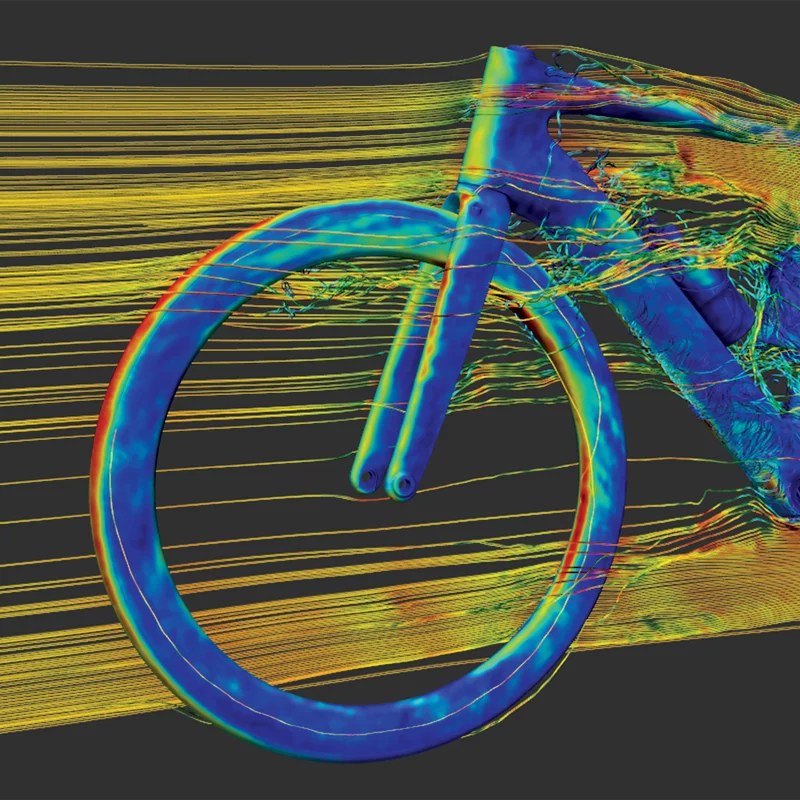
Form follows function. We design for measured loads and measured airflow.
FEA structural analysis for stiffness and strength, CFD for drag, then prototypes and testing. The concave down tube of the Syn, protected by three international patents, came out of this loop: it is the reason the Syn gets faster, not slower, when a bottle is fitted.
04
Aerodynamics
CFD with LES turbulence modelling, rotating wheels and complete bikes, validated in the wind tunnel.
In 2012 Velocite and Taiwan's National Center for High-performance Computing (NCHC) agreed to optimise bicycle aerodynamics with CFD and genetic algorithms on the NCHC GPU supercomputer. We also work with National Cheng Kung University. We offer this capability to other companies.
05
Testing
Nothing with safety implications goes to production without EN testing and live rider testing.
Every Velocite carbon frame and fork was checked for alignment, weight and stiffness, and the stiffness method was validated by independent test centres, EFBe and CHC among them.